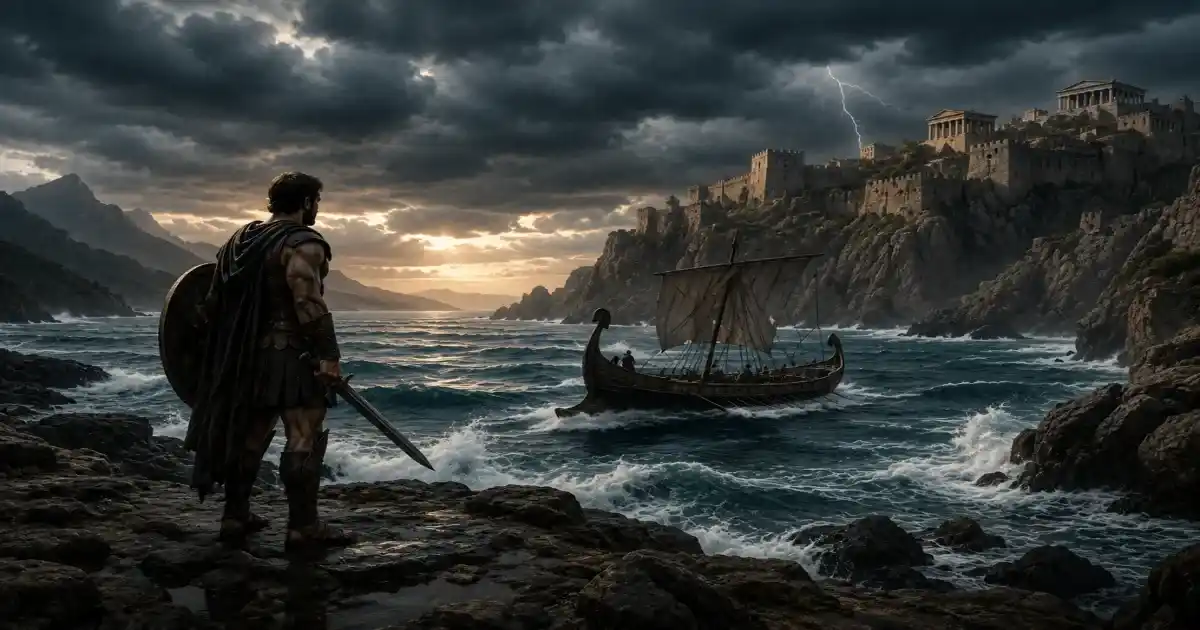
The ending of The Odyssey reveals that Odysseus’ greatest battle was never just against monsters, gods, or the sea — it was against time, loss, and the person he became during his journey home. The final moments focus on his return to Ithaca, his reunion with Penelope and Telemachus, and the emotional cost of finally reaching home.
Spoiler Warning
Warning: This article contains major spoilers for The Odyssey (2026), including the ending, character arcs, final scenes, and story details.
If you have not watched the movie yet, I recommend experiencing Christopher Nolan’s adaptation first because the journey itself is a huge part of the emotional impact. The film is designed around mystery, survival, memory, and the question of whether a person can truly return home after being changed by everything they have experienced.
The Odyssey (2026) Quick Facts
Movie Overview
When I started watching The Odyssey, I quickly realized that this was not just a traditional mythological adventure about a warrior trying to reach his kingdom. The movie presents Odysseus’ journey as a deeply personal story about identity, regret, loyalty, and the meaning of home.
Based on Homer’s ancient Greek epic poem The Odyssey, the film follows Odysseus, the King of Ithaca, after the Trojan War. Instead of returning home immediately after victory, he becomes trapped in a dangerous journey across the seas, facing supernatural forces, powerful creatures, and impossible choices.
What makes this adaptation different is the way it focuses on Odysseus as a human being rather than only as a legendary hero. As I watched his journey unfold, I felt that every challenge was slowly removing the image of the unstoppable warrior and showing the exhausted man underneath.
The movie explores his encounters with mythical figures, his struggle against fate, and his desperate desire to return to his wife Penelope and son Telemachus. But the biggest question throughout the film is not simply “Will Odysseus make it home?”
The real question is:
“Will Odysseus still be the same person when he finally gets there?”
The Odyssey Ending Explained
The ending of The Odyssey is emotional because it completes a journey that has lasted far longer than a physical voyage. Odysseus does eventually return to Ithaca, but the person who arrives home is not the same king who left years earlier.
Throughout the movie, Odysseus faces countless obstacles that test his intelligence, courage, and patience. However, each challenge takes something from him. He loses companions, experiences betrayal, and witnesses events that force him to question his own decisions.
By the time he reaches Ithaca, the movie makes it clear that his greatest victory is not defeating another enemy — it is reconnecting with the life he thought he had lost forever.
Odysseus Finally Returns to Ithaca
The final act begins when Odysseus reaches the shores of Ithaca in disguise. Instead of immediately announcing his return, he chooses to observe what has happened during his absence.
This moment is important because it shows how much he has changed.
Earlier in the movie, Odysseus is known for his confidence and pride. He is a brilliant strategist who believes he can overcome any situation through intelligence. But after years away from home, he understands that rushing forward without understanding the consequences can destroy everything.
When I watched this scene, I felt that the silence was more powerful than any battle sequence. Odysseus is finally standing in the place he fought so hard to reach, but he cannot simply walk in like the hero who left.
He has become a stranger in his own home.
The film uses this moment to show one of its biggest themes:
Coming home is not always about reaching a place. Sometimes it is about finding your place again.
The Truth About Penelope’s Situation
One of the most emotional parts of the ending focuses on Penelope and what she has endured during Odysseus’ absence.
While Odysseus has been fighting to survive across the seas, Penelope has been fighting her own battle inside Ithaca. Many believe Odysseus will never return, and she faces pressure to accept a new future.
However, Penelope refuses to give up.
The movie highlights that Penelope is not simply waiting for Odysseus to return. She is actively protecting their home, their family, and the memory of the man she believes is still alive.
When Odysseus finally reveals himself, the reunion is not treated like a typical heroic celebration. Instead, it is quiet, emotional, and filled with years of pain.
I personally think this choice makes the ending much stronger because it shows that love does not erase trauma. Both characters have changed during their time apart.
They are reunited, but they also have to learn who they have become.
The Final Confrontation in Ithaca
After returning home, Odysseus must deal with the enemies who have taken control of his kingdom. The confrontation is one of the most anticipated moments of the story because it brings his entire journey back to where it started.
However, the movie does not present this as just another action sequence.
Instead, the confrontation represents Odysseus reclaiming his identity.
Throughout the journey, he has been stripped of his title, his army, and his reputation. He has been reduced from a powerful king to a survivor fighting against impossible circumstances.
The final battle is therefore not only about defeating his enemies — it is about proving that Odysseus still belongs to Ithaca.
One thing viewers will notice is that the movie focuses heavily on strategy rather than brute force. This reflects who Odysseus has always been. His greatest weapon was never his strength; it was his ability to think several steps ahead.
What Happened to Odysseus?
By the end of The Odyssey, the biggest transformation is not what happens physically to Odysseus — it is what happens emotionally.
When Odysseus begins his journey, he is introduced as a legendary warrior, a clever king, and a man who believes his intelligence can overcome any obstacle. He is confident, fearless, and sometimes even arrogant because he has spent his entire life proving that he is always the smartest person in the room.
But the journey changes him.
Every challenge takes away a part of the man who left Ithaca. He loses friends, faces impossible choices, and experiences situations that force him to question his own actions. The movie slowly shows that surviving is not the same as winning.
When I watched Odysseus finally return home, what stood out to me was how different he felt compared to the beginning of the film. He is still the same strategist, but the confidence has been replaced by wisdom. He no longer sees himself as an untouchable hero.
He has become someone who understands the value of the people waiting for him.
This is why the ending feels much more emotional than a simple “hero returns home” story.
Odysseus does not come back looking for glory. He comes back looking for peace.
The movie also makes an important point about trauma. Even though Odysseus physically reaches Ithaca, a part of him is still carrying every loss and every mistake from his journey. His victory is not about forgetting the past; it is about accepting it.
That is what makes his character arc so powerful.
What Does the Final Scene Mean?
The final scene of The Odyssey is filled with symbolism, and it focuses on the idea that home is more than just a location.
At first glance, the ending appears to be about Odysseus returning to his kingdom and restoring his place as king. But the deeper meaning is about forgiveness, identity, and reconnecting with the people who matter most.
When I watched the final moments, I felt that the movie was asking a simple but powerful question:
After everything you have experienced, can you still become the person you were meant to be?
Odysseus spends years trying to return to Ithaca, but the final scene shows that the hardest part was not the journey across the ocean. The hardest part was accepting that he and the world around him had changed.
Penelope has changed.
Telemachus has changed.
Even Ithaca itself has changed.
The final moments show that returning home does not mean going back to the past. Instead, it means creating a new future with the people who survived the journey with you.
The scene between Odysseus and his family is especially important because it contrasts with the massive battles and mythical encounters earlier in the movie.
The film begins with war and ends with connection.
It begins with a man trying to become a legend and ends with a man simply trying to be a husband, father, and king again.
Post-Credit Scene Explained
Unlike many modern blockbuster movies, The Odyssey does not use its ending simply to tease another adventure. The post-credit sequence focuses more on the themes of the film rather than introducing a completely new storyline.
The scene gives viewers a final reflection on Odysseus’ journey and the consequences of everything he experienced.
When I watched the post-credit scene, I noticed that it continued the movie’s biggest theme: the relationship between humans and destiny.
Throughout the film, Odysseus constantly struggles between making his own choices and accepting forces beyond his control. The post-credit moment suggests that even after returning home, the effects of his journey will remain with him.
The scene also leaves room for interpretation. Some viewers may see it as a hint toward future stories from Greek mythology, while others may see it as a final reminder that every journey changes the person who takes it.
Rather than giving audiences a simple setup for another movie, the post-credit scene works as an emotional final chapter.
Hidden Details & Easter Eggs
One of the reasons The Odyssey is such a rewarding watch is because the movie includes several details that become more meaningful after understanding the full story.
1. The Importance of the Bow
The bow is one of the most important symbols connected to Odysseus.
Throughout the movie, it represents more than just a weapon. It represents identity, legacy, and the connection between Odysseus and Ithaca.
When the bow appears in the final act, it reminds viewers that Odysseus is not simply fighting to defeat enemies — he is proving who he truly is.
2. The Sea as a Symbol
The ocean is almost like another character in the movie.
At the beginning, the sea represents adventure and opportunity. But as the story progresses, it becomes a symbol of uncertainty, punishment, and personal transformation.
Every storm and obstacle represents another challenge Odysseus must overcome internally.
When you rewatch the movie, you will notice that the ocean scenes are not only about survival. They reflect Odysseus’ emotional state.
3. Penelope’s Strategy
Many viewers focus on Odysseus’ intelligence, but the movie intentionally highlights that Penelope is equally strategic.
Her ability to survive Ithaca’s political pressure mirrors Odysseus’ ability to survive the outside world.
The film creates a parallel between them:
- Odysseus fights battles across the sea.
- Penelope fights battles inside the palace.
Both characters are survivors.
4. References to Greek Mythology
Fans of Homer’s original epic will notice several references throughout the movie.
The film includes elements connected to:
- The Trojan War
- The journey home
- Greek gods and mythology
- Legendary creatures
- Ancient ideas about fate and honor
However, the movie does not simply recreate the mythology. It uses these elements to explore modern themes like loss, family, and human resilience.
Will There Be a Sequel?
At this time, there is no official confirmation of a sequel to The Odyssey.
The story itself is based on Homer’s epic, which means there are additional mythological stories that could potentially be explored. Greek mythology has many characters and events that could continue the world introduced in the film.
However, the ending of The Odyssey also works as a complete conclusion.
The emotional journey of Odysseus reaches its natural ending when he returns home and reconnects with his family.
If a sequel happens, it would likely depend on audience response, box office performance, and the creative direction chosen by the filmmakers.
For now, the movie stands as a complete story about one man’s journey through war, loss, and redemption.
The Odyssey Ending Explained: Quick Summary
FAQs
1. What happens at the end of The Odyssey?
At the end of The Odyssey, Odysseus finally returns to Ithaca after years away and reunites with Penelope and Telemachus. He restores his place in his kingdom while accepting how much he has changed during his journey.
2. Is Odysseus alive at the end of the movie?
Yes, Odysseus survives his journey and returns home. However, the ending focuses more on his emotional transformation than simply his physical survival.
3. Does Penelope recognize Odysseus immediately?
The movie presents their reunion as an emotional moment built around trust, memory, and years of separation rather than a simple reveal.
4. What is the meaning of the ending of The Odyssey?
The ending represents the idea that true victory is not about defeating enemies or gaining power. It is about finding your way back to the people and values that matter most.
5. Does The Odyssey have a post-credit scene?
Yes, the movie includes a post-credit moment that expands on the themes of destiny, identity, and the lasting impact of Odysseus’ journey.
6. Will Christopher Nolan make The Odyssey 2?
There is currently no confirmed sequel. While Greek mythology offers more stories, the filmmakers have not announced a continuation.
7. Is The Odyssey based on a true story?
No, The Odyssey is based on Homer’s ancient Greek epic poem. The story combines mythology, legends, and fictional characters rather than historical events.
8. Is The Odyssey worth watching?
For viewers who enjoy epic adventures mixed with emotional storytelling, mythology, and character-driven dramas, The Odyssey offers much more than a traditional action movie. Its strongest moments come from exploring what happens to a person after surviving an impossible journey.